
What Grant County VINELink Covers
Kansas Victim Information and Notification Everyday, or Kansas VINE, is the official event-notification route for adults housed in Kansas county jails. The Kansas Attorney General describes it as free, confidential, voluntary, open to the public, and supported by multilingual operators. For Grant County, its proper role is to search for one person reported by Grant County Jail and watch for a later custody event.
The boundary matters. Kansas VINE expressly excludes Kansas Department of Corrections state-prison offenders. KASPER is the correct source after a transfer to KDOC. VINELink also is not the federal Bureau of Prisons locator, an ICE locator, a court docket, or a permanent archive. A person can leave Grant County Jail and remain confined elsewhere.
The official Kansas VINELink interface shows the state-specific search starting point.
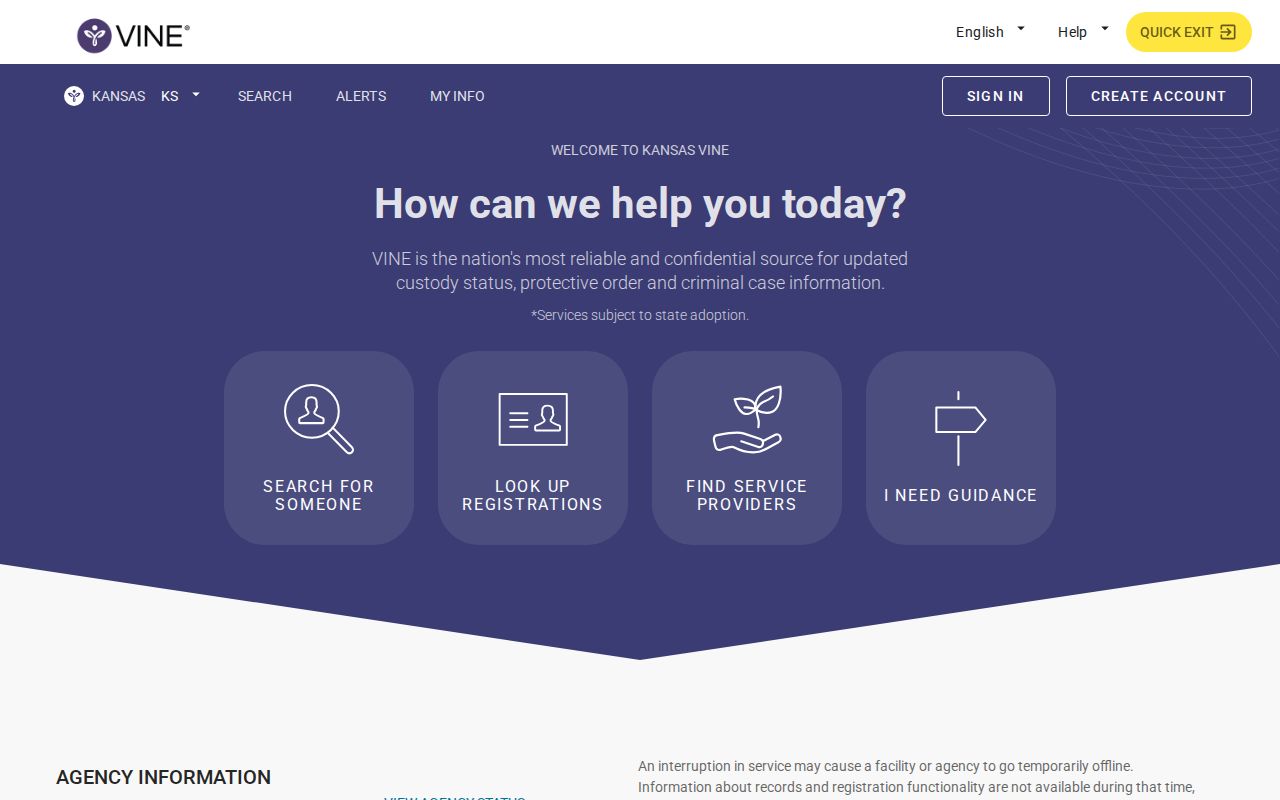
Use the live page for current results because the image documents the access route, not any person’s present status.
How to Search Grant County VINELink
Begin at the official Kansas VINELink search. The task is identity matching, not merely finding a similar name. Initials, aliases, suffixes, spelling variants, and common names can create a false hit or hide the right record. Use only the identifiers displayed by the service.
- Select Kansas and open the custody search.
- Enter the person’s name or available identifying number.
- Compare matches with the non-sensitive details shown.
- Open the matching record and note the reporting agency and status.
- Ask GCSO to confirm a reported release or transfer.
The Grant County released-inmate search guide explains how to pair the VINE event with a jail entry and court docket. That second source is vital when an alert does not name the receiving agency.
What a Grant County VINE Record Shows
VINELink is an event and status service. Its display can vary by agency and record, so report only fields actually present. It is not a certified release certificate and does not explain every legal effect of leaving one jail.
| Field | What it shows |
|---|---|
| Name or identifier | Helps separate similar matches. |
| Reporting agency | Names the jail or agency supplying the event. |
| Custody status | Shows the status now reported to VINE. |
| Facility or location | Shows a custody location when supplied. |
| Event type | May distinguish release, transfer, or escape. |
A released result supports the statement that the reporting jail recorded a custody change. It does not prove charges ended, all holds cleared, or every jurisdiction released the person. A transfer calls for a search of the receiving system.
Register for a Grant County Release Alert
Registration is available while the matching person is in custody. Current Kansas materials list telephone, text, email, app, and TTY channels. Choose a method you can monitor and follow the confirmation prompt. Registration cannot retroactively create notice for an event already processed.
- Open the correct in-custody record.
- Choose notification and select an offered channel.
- Enter and confirm the requested contact information.
- For telephone registration, create and retain the four-digit PIN.
- When called, enter the PIN followed by the number sign to acknowledge the alert.
Email registration uses no telephone PIN and sends one message on change. The Kansas VINE assistance number is 1-866-574-8463, and current Kansas materials list TTY at 1-866-847-1298. GCSO remains the source for its own jail record.
Grant County Release Alert Limits
VINE data can lag the physical event. A call may arrive after staff process a move, and a new booking can take time to appear. Do not rely on the service for an urgent safety decision. Contact emergency services for immediate danger and the record custodian for accuracy.
If the county says transfer to KDOC, use KASPER. It covers qualifying people sentenced to the Secretary of Corrections since 1980, including prisoners, specified supervised people, and discharged people.
Reading Grant County Custody Events
Release, transfer, and escape describe different events. Release may still involve bond terms, probation, another case, or a separate hold. Transfer means the person left one reporting jail for another custodian. Escape is an unauthorized departure and must never be restated as an ordinary release.
When the event says transfer, ask GCSO to identify the destination if releasable. Then use the destination’s official system. A KDOC institutional location confirms continued state custody. An ICE match may indicate federal civil detention. Another county jail should be checked through that county’s official source.
Pair Grant County Alerts with Records
The Grant County District Court docket can explain why jail staff were authorized to act. Search the Kansas District Court Public Access Portal by exact party name, narrow to Grant County and criminal cases, and verify the case number and event dates. Bond, dismissal, sentencing, revocation, and transport entries have different meanings.
A bond order does not prove the person satisfied bond or cleared another hold. A sentence entry does not supply the physical release time. Pair the docket with the jail-book and release entry. A focused records request can seek the booking number, admission time, release time, manner or destination, and releasing authority.
When Grant County VINE Does Not Apply
Use KASPER for the state-prison phase. It may show status, movement location and date, supervision level, parole office, conviction information, and Anticipated Release Date. That date is an estimate. Look for current status and a later movement entry.
Use the BOP Inmate Locator for a sentenced federal prisoner. A past release date with no institution and a Released or Not in BOP Custody location supports departure from BOP, but another jurisdiction may apply. Use ICE’s separate locator for civil immigration detention.
VINE Is Not a Grant County Registry
The KBI Registered Offender Search is a separate, offense-specific record. It covers people with a statutory Kansas registration duty. A match may offer post-custody information, but it does not certify a release date or manner.
Most people released from jail have no registration duty, so absence from that registry says nothing about custody. Keep the VINE event, jail record, court disposition, and registry role distinct.
Grant County VINE Identity Matching
A VINE result must be tied to the intended adult before an alert is registered or repeated. Start with exact spelling, then test known aliases or a supplied identifier. Compare the reporting agency and the non-sensitive details shown. A Grant County inquiry should not be attached to a same-name record from another Kansas jail.
Use stable identifiers from connected official records. A Grant County court case number links to the docket. A jail booking number links to the local event. A KDOC number belongs to KASPER, and a BOP register number belongs to the federal locator. These identifiers are not interchangeable, but together they prevent name-only mistakes.
If the displayed age, agency, event date, or other detail conflicts, stop. Do not choose the nearest result. Contact GCSO with the information already known and ask whether the adult remains in its custody.
Grant County Notification Follow-Up
After a release alert, record the event type and time the notice arrived, then confirm the underlying jail record. The notification time may differ from the physical release timestamp because data transmission and automated calls can lag. Ask GCSO for the recorded time rather than presenting the call time as the release time.
After a transfer alert, identify the receiving agency. Search KASPER for a state commitment, another county’s official jail source for a county transfer, ICE for a documented immigration handoff, or the federal docket and BOP where applicable. Do not register the same person across unrelated systems merely to see which one returns a result.
After an escape alert, follow official safety instructions and do not describe the event as release. VINE is designed to tell the registrant that custody changed; the responsible agency supplies the official details.
Kansas VINE Access Channels
Kansas materials provide online VINELink, mobile app access, telephone support, text and email notification where offered, and a TTY line. These are access channels to the same notification program, not separate official records. Choose the channel that can be monitored reliably.
Phone alerts repeat until acknowledged with the four-digit PIN followed by the number sign. Protect that PIN because it confirms receipt. Email sends one change message and does not use the phone PIN. Follow the live registration screen because channel availability can depend on the record.
Kansas VINE is free and confidential, but it is not guaranteed to catch every timing need. The Kansas guidance says not to depend on it alone. Direct agency confirmation remains essential.
Record the reporting agency, event label, and check time when accuracy matters. Those few details make later confirmation much easier.
Grant County readers should also distinguish notification registration from a search result. A search can show the status reported at that moment. Registration asks the system to send a later event through an offered channel. Neither action orders release, changes a court case, or calculates a sentence. If the matching adult is already shown as released, registration cannot recreate the earlier notice. Request the GCSO jail entry and read the court docket instead.
When staff confirm that the person remains at Grant County Jail, an in-custody VINE result is consistent with the direct check. When the two sources differ, note the time of each check and ask GCSO to clarify. Data transmission delay is more plausible than an unsupported conclusion about release. The originating office remains the authority for its event.