
Grant County Scheduled vs Actual Release
A scheduled or projected date is a forecast. Kansas Department of Corrections uses the official term Anticipated Release Date in KASPER. It can estimate the end of a state-prison portion after credits are applied, but it is not a promise of physical departure. An actual status or movement entry, a discharge record, or the local jail’s release timestamp is evidence of an event that has occurred.
| Person or event | Date source | What confirms departure |
|---|---|---|
| Grant County pretrial detainee | Court orders and bond status, usually without a fixed release day. | GCSO jail-book release entry and destination or manner. |
| Grant County local sentence | Sentencing order, jail credit, and any lawful local policy. | Grant County Jail release record. |
| KDOC state prisoner | KASPER Anticipated Release Date and KDOC sentence computation. | Later KASPER status or movement, or KDOC confirmation. |
| Parole candidate | Eligibility and hearing information, not a guaranteed exit date. | PRB decision followed by KASPER movement and supervision status. |
| Federal prisoner | BOP locator date. | BOP Released or Not in BOP Custody status, which does not rule out other custody. |
A person leaving the Grant County Jail for KDOC, another county, federal custody, or ICE has left the local facility but has not entered the community. The record should name the custody system and event instead of making the broad claim that the person is free.
Find a Grant County Inmate Release Date
Choose the route by custody type before searching. KASPER is a state corrections repository, not a Grant County booking database. Kansas VINE covers adult county jails and excludes KDOC prisons. The court explains legal authority, while the jail records physical release.
- Identify whether the person is in the Grant County Jail, a KDOC institution, a federal facility, or another system. Do not infer the system from conviction county alone.
- For KDOC, open the official KASPER search. Use exact name and identifiers, then open the complete record.
- Read the Anticipated Release Date with current status, institution or supervision location, movement dates, sentence data, and any later entries. An old date may have been superseded.
- For a Grant County Jail case, check the Grant County District Court docket for bond, dismissal, sentence, commitment, revocation, or jail-credit orders. Then ask GCSO for the jail-book release entry.
- For a pending county-jail event, use Kansas VINE for a custody-change alert, but distinguish release from transfer or escape and confirm the result with GCSO.
- After the expected day, recheck the same official system. Record the actual status, movement date, reporting agency, and destination when available.
The broader Grant County released-inmate lookup covers the request form and the fields that help distinguish bond, time served, court order, and transfer. No official local current-inmate roster or recent-release portal was found, so a missing online name is not release proof.
Grant County KASPER Date Fields
KASPER means Kansas Adult Supervised Population Electronic Repository. KDOC says it covers people sentenced to the Secretary of Corrections since 1980, including those incarcerated, under post-incarceration supervision, or discharged. It excludes people sent to Kansas under the interstate compact and is not a complete criminal-history service.
| KASPER field | How to use it for a release-date check |
|---|---|
| Anticipated Release Date | Treat it as KDOC’s changeable estimate, not an actual release record. |
| Current status and location | Distinguish an institution from a supervision office or discharge status. |
| Movement location and date | Look for the event after the expected date and any later return or transfer. |
| Supervision office and level | Support release from prison into continuing KDOC control. |
| Convictions and cases | Match the person and identify sentence components that may affect computation. |
| Disciplinary findings | Provide context for possible good-time withholding or forfeiture. |
The KDOC locating guidance explains the repository’s scope and the Anticipated Release Date label.

Grant County Release Dates and Kansas Good Time
The common statement that every Kansas prisoner serves 85 percent is too broad. For offenses committed on or after July 1, 1993, K.S.A. 21-6821(b) generally caps good time at 15 percent of the prison portion. That general cap produces the familiar shorthand, but the same statute allows up to 20 percent for specified offense-level and date groups.
The 20-percent categories include nondrug severity levels 7 through 10 committed on or after January 1, 2008; drug severity levels 3 through 4 committed from January 1, 2008 through June 30, 2012; and drug severity levels 3 through 5 committed on or after July 1, 2012. Subsection (e) also permits up to 120 additional days for eligible prisoners serving only listed severity-level offenses who complete a GED, technical or vocational education, substance-use treatment, or another secretary-designated recidivism-reduction program. Sex-offender-treatment completion is excluded from that credit.
The official statute page shows why no single percentage should be applied to every Grant County case.
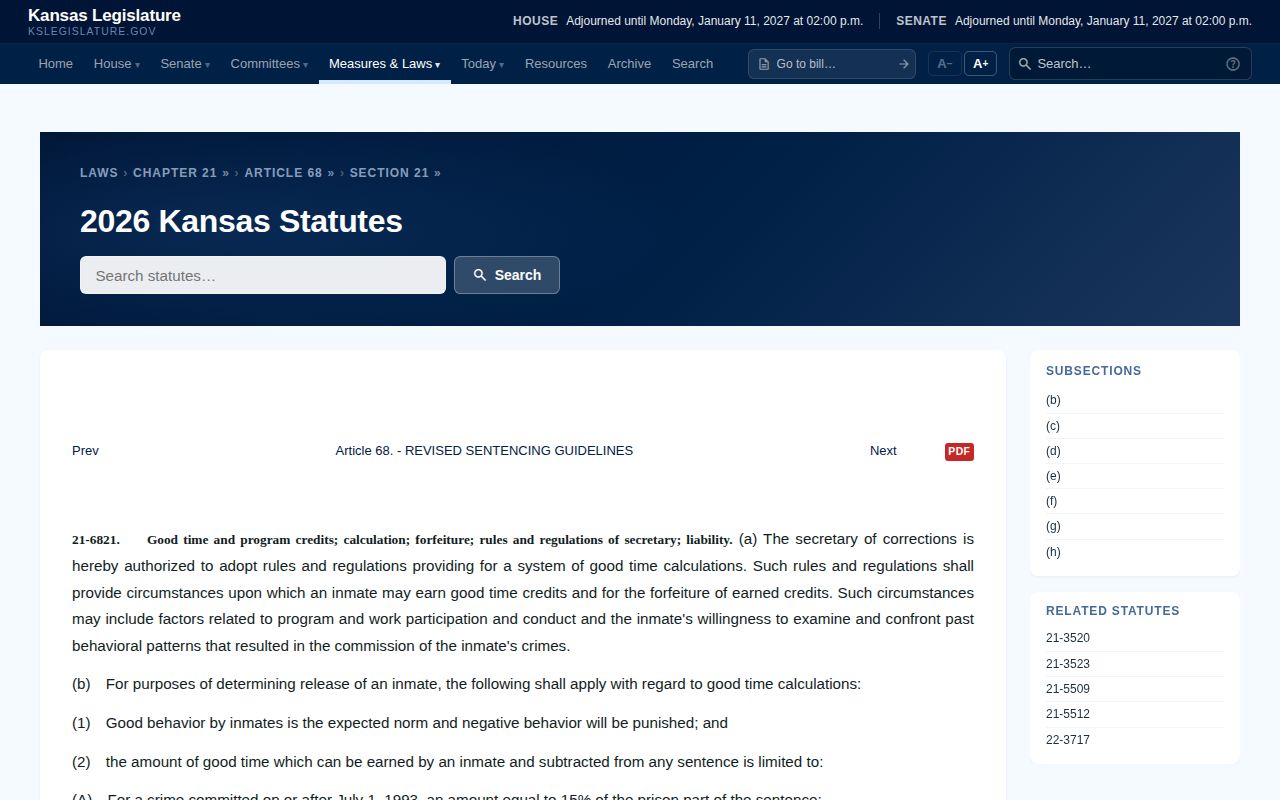
Neither illustration determines a real release date. Consecutive cases, jail credit, amended sentences, forfeiture after discipline, restoration, program eligibility, and statutory rules for multiple crimes can change the result. Credits must be earned and retained. Case-specific questions belong with KDOC Sentence Computation at 785-296-3317.
Why Grant County Release Dates Change
An anticipated date can move earlier or later without the public page immediately showing why. Read the full sentence and movement history rather than isolating one number.
| Factor | Possible effect | Source to verify |
|---|---|---|
| Good time earned or restored | May advance the anticipated end of the prison portion within statutory limits. | KDOC sentence computation and KASPER. |
| Good time withheld or forfeited | May move the date later after disciplinary action. | KDOC record and disciplinary history. |
| Program credit | May reduce time for an eligible sentence after qualifying completion. | KDOC under K.S.A. 21-6821(e). |
| Jail credit or amended sentence | May change the calculation after a court order. | Grant County District Court journal entry and KDOC. |
| Consecutive sentence or another case | May extend custody beyond a date associated with one count. | All sentencing records and the computation. |
| Detainer or hold | May result in transfer rather than community release. | Releasing custodian and receiving agency. |
| Parole decision or revocation | Can affect an indeterminate-sentence release or return to custody. | Prisoner Review Board and later KASPER status. |
For older indeterminate sentences, K.S.A. 22-3725 and K.S.A. 22-3717 use a different parole and conditional-release framework. PRB explains that a minimum term of at least two years may reach eligibility after half the minimum if all good time is earned, while a one-year minimum may reach eligibility after nine months. Eligibility permits consideration; it does not authorize a reader to predict release.
Grant County Jail Release Date Limits
KDOC’s 15-percent and 20-percent rules should not be imported into a county-jail calculation. A Grant County pretrial release depends on a judge’s order, satisfaction of bond conditions, unresolved holds, and jail processing. A local sentence depends on the court’s jail term and credit plus any lawful jail policy that applies.
No Grant County good-time, weekend-release, or release-time policy was found in the official material. That evidence gap matters. Ask the Grant County Sheriff’s Office at 210 E. Central Avenue, Ulysses, 620-356-3500, for the relevant jail record or policy rather than assuming state-prison rules control. The official Sheriff page is the live contact source.
The Grant County District Court, in the courthouse at 108 S. Glenn, can supply public bond and sentencing orders. Its docket explains legal authority, but GCSO supplies the physical release timestamp. If an order commits a person to KDOC, local jail departure is a transfer, not release into the community.
A focused written request should identify the person, booking or case number, and the date range, then ask for the existing jail-book release and destination fields in the format maintained. Kansas open-records law does not necessarily require GCSO to calculate a projected day or create a timeline that it does not already keep. If the age of the record matters, ask the custodian which retention schedule applies because no online Grant County release archive or web-retention period was verified.
Confirm a Grant County Actual Release
After an anticipated day passes, reopen KASPER and inspect the current status, movement date, and location. A supervision office can support release from prison into postrelease control. A discharge status supports completion of KDOC control. If the entry is unclear or stale, use KDOC Sentence Computation rather than estimating from the original sentence.
For a county-jail event, Kansas VINE can provide a release, transfer, or escape notification while the person is in custody. Those event types are not synonyms. Follow the alert with GCSO and the court record. The detailed VINELink Release Check explains the one-person search and notification process.
For a state-prison event, VINE is the wrong coverage channel because Kansas expressly excludes KDOC prisoners from that service. Use KASPER and KDOC instead. For federal custody, use the Bureau of Prisons locator; a past release date or “Not in BOP Custody” location supports departure from BOP but cannot rule out a state, local, or immigration hold. ICE custody requires its separate locator. These distinctions prevent a date from one agency from being presented as the end of every form of custody.
Save the source name, the date checked, and the exact status language in the public entry. Dynamic records can lag or change. If KASPER still shows an institution after its Anticipated Release Date, ask KDOC whether credits, discipline, sentence changes, or another computation issue moved the date. If KASPER shows a supervision office, verify that the movement represents release into supervision rather than relying on the forecast alone. This last check turns an estimate into a sourced account of the actual custody change.