
Releases from Grant County Jail
An adult may leave Grant County Jail on bond, recognizance, time served, dismissal, court order, or transfer. Only some events mean a return to the community. A transfer to KDOC, another jail, BOP-related custody, or ICE means physical departure from Grant County custody while detention continues elsewhere. The GCSO jail-book and release entry should identify the event or destination if releasable.
Pair that entry with the Grant County District Court docket. A bond order supplies authority but does not prove the bond was satisfied or another hold cleared. A sentence or transport order can explain why a person moved. Kansas VINE adds an event alert, but its release or transfer notice is not a certified record.
How to Confirm a Release from Grant County Jail
No official local release search exists. Use the Grant County released-inmate search and this evidence chain:
- Search Kansas VINELink for the named adult and note the reporting agency and status.
- Call GCSO at 620-356-3500 and ask whether the person remains in county custody.
- If not, ask for the recorded release date, time, manner, or receiving agency.
- Search the Grant County court case for the order behind the event.
- For a transfer, search the receiving system instead of stating that the person is free.
Use KASPER after a state transfer, the BOP locator for a sentenced federal prisoner, and ICE’s separate locator for immigration detention. Names alone are weak identifiers, so compare booking, court, or agency numbers and event dates.
Grant County Jail Records and Contact
The Grant County Sheriff’s Office operates the jail at the Grant County Law Enforcement Center. Request the narrow jail record from that office or use the county Freedom of Information route.
210 E. Central Avenue
Ulysses, KS 67880
Phone: 620-356-3500
Fax: 620-356-1038
Official Sheriff page
The county form should identify the person, booking number if known, admission date, requested release date and time, manner or destination, releasing authority, and bond field. Under Kansas open-records law, the custodian may quote reasonable staff or reproduction charges and require advance payment.
About Grant County Jail
Grant County Jail is the county’s local adult detention facility. The official staff page says the jail was built in the 1970s, has capacity for 40 prisoners, and is staffed by four full-time jail deputies working two 12-hour shifts. Those facts describe the facility, not its current population or annual release volume.
The Sheriff page does not publish a named roster, release list, booking-photo gallery, or release policy. Never fill those gaps with a commercial page for another Grant County.
The official Sheriff staff and jail page documents the facility facts used here.
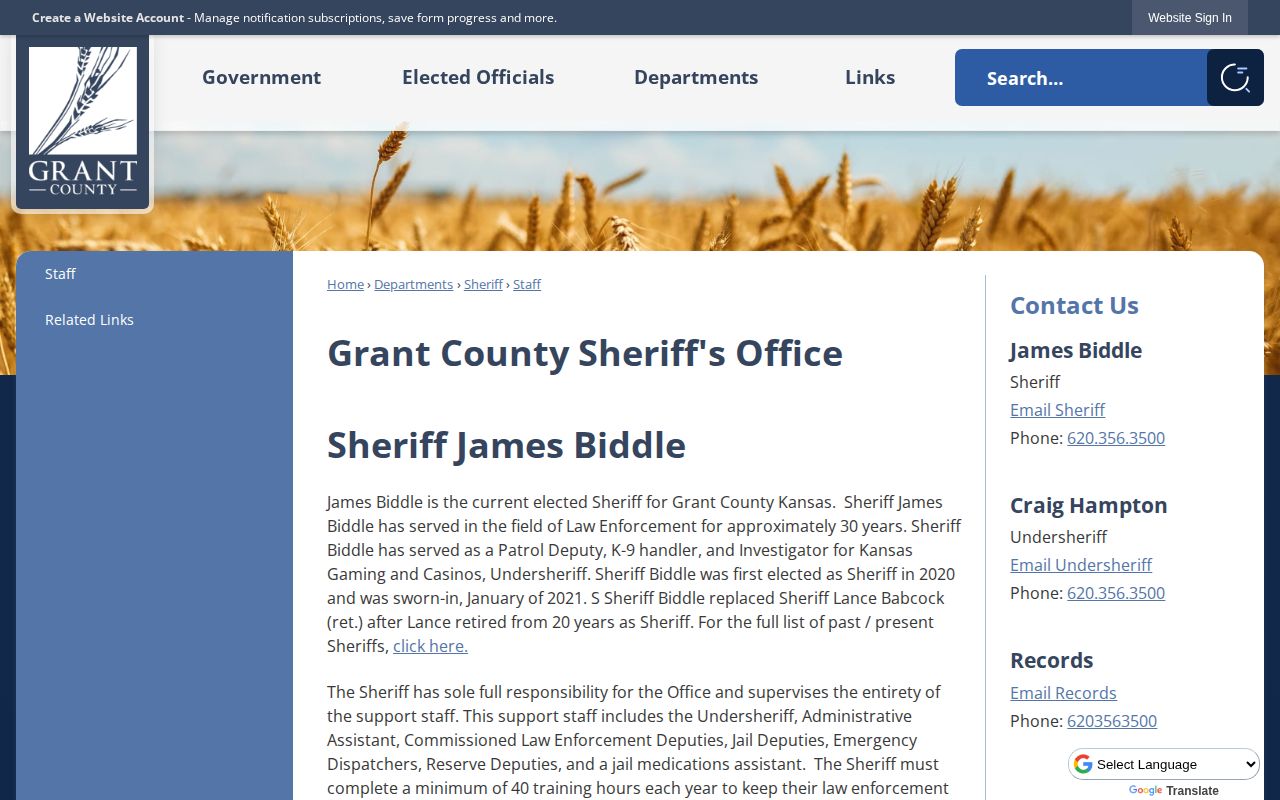
The live official page should be checked for later staffing or facility changes.
Grant County Jail Transfer Warnings
A felony sentence can move a person from the jail to KDOC. The county disappearance is then a transfer, not community release. KASPER covers qualifying people sentenced to the Secretary of Corrections since 1980 and can show state status, location, movement date, supervision, and discharge.
A county release to ICE is also continued custody in another system. Research found no official evidence that Grant County Jail is an ICE contract detention facility, but a detainer handoff remains possible. Obtain the county release reason before checking ICE.
Grant County Jail Facility History
The jail’s 1970s construction matters because local officials later considered a new law-enforcement or justice-center proposal. Grant County voters rejected the related bond and sales-tax questions in 2023. That history does not change the current release route: GCSO remains the source for the local jail event.
Official visitation material describes digital visitation but does not state release times, exit doors, transport practices, or property pickup procedures. Those details should not be invented. Ask jail staff about a specific current procedure without treating an operational answer as a permanent policy.
What a Grant County Jail Record May Establish
A useful request asks who was held, when the booking began, when the person left, and what manner or destination the jail recorded. The county has not published its exact field schema, so a requester should ask for the booking number, arrest or admission date and time, release date and time, holding authority, releasing authority, bond information recorded by the jail, and release manner or destination. A narrow field request is different from asking for an entire investigative file.
The Kansas Attorney General distinguishes the open jail book from criminal-investigation material. That difference can affect what GCSO produces. If a requested item is withheld, the response should identify the legal grounds. A production may also contain redactions. Report what the released record actually says rather than treating an omitted field as proof that no event occurred.
Online retention cannot be stated because Grant County publishes no release archive. A written response is therefore more durable than a failed web search. Keep the response with its request date, since a later corrected record may differ.
Grant County Court and Jail Timing
The Grant County District Court is at 108 S. Glenn in Ulysses and is part of the 26th Judicial District. Its clerk’s office handles court records, while GCSO handles the jail processing record. These offices answer linked but different questions. The court can show an order setting bond, dismissal, sentence, revocation, or commitment. The jail can show when staff completed the physical event.
Search the statewide Public Access Portal by exact party name and narrow to Grant County criminal cases. Confirm the case number, charge, and event dates before deciding that a docket belongs to the same person. Read the journal entry or order, not just the case-status label. “Case closed” does not identify whether a person was acquitted, dismissed, sentenced, or transferred.
A time-served sentence in one case does not clear a warrant, detainer, another county hold, probation matter, or consecutive sentence. A dismissal likewise may not resolve every booking basis. Pair the correct court case with the matching jail event.
Identity Checks for Grant County Jail Releases
Name-only matching is risky. Common names, initials, suffixes, aliases, spelling variations, and name changes can connect the wrong jail event to the wrong person. Use a booking number, court case number, date of birth when lawfully displayed, booking date, charge, and event date as available. Do not resolve a mismatch by assuming that two records describe the same adult.
Dates also need labels. Booking date means intake. A bond-order date reflects court authority. Release date and time reflect jail processing. A KASPER movement date belongs to the state system. An anticipated date is an estimate. Stating the label beside the date prevents a reader from mistaking a court action for physical departure.
When two official sources conflict, ask the custodian of the disputed event. GCSO controls its jail entry, the court controls its order, KDOC controls its movement and computation data, and BOP controls its locator. Preserve the conflict until the responsible office corrects or explains it.
Grant County Jail Release Vocabulary
Use the precise event shown by GCSO. Bond and recognizance return an adult to the community under court terms. Time served completes the jail component but may leave supervision or another matter. Transfer and extradition continue custody elsewhere. Dismissal ends a charge but may not resolve another hold. A detainer handoff identifies a new custodian. These terms should never be reduced to a bare claim that someone “got out.”
The question is always release from which custody. That wording keeps a Grant County departure distinct from the end of every legal obligation.
When the record lacks a clear term, ask GCSO for clarification instead of choosing one.
Release verification should also account for the scope of each source. Kansas VINE supplies a near-real-time county-jail event but not a permanent certificate. The court docket supplies legal authority but not the jail’s processing time. KASPER begins only when a qualifying state corrections record exists. BOP and ICE cover separate federal populations. For an adult booked at Grant County Jail, start with GCSO and move to another system only when an official event supports that move. This ordered process reduces false matches, avoids calling a transfer a community release, and preserves the difference between leaving one building and ending every form of custody.