
Grant County Released Inmate Records
A person has left Grant County Jail custody when the jail records an exit. The reason still matters. Bond or recognizance can return someone to the community under court terms. Time served ends the local jail part of a sentence, though another case or supervision term may remain. A dismissal can remove the legal basis for the case at issue. By contrast, transport to another jail, KDOC, federal custody, or ICE is a transfer between systems.
The Grant County Sheriff’s Office controls its own jail-book and release event. Kansas VINE can report a county-jail custody change. Grant County District Court holds the bond, dismissal, sentence, commitment, or transport order that may explain the change. When the record names another custodian, continue with that agency instead of calling the transfer a community release.
- Time served
- Credit or completion that satisfies the jail part ordered in a case.
- Transfer
- Departure from one facility into another agency’s custody.
- Postrelease
- Kansas supervision that follows the prison portion of a determinate sentence.
- Discharge
- Completion of the custody or supervision control identified by the issuing agency.
Grant County Release Types Explained
Release labels should be copied with care. “Released” in a VINE alert means the reporting jail recorded a custody event, but the alert may not show whether another agency took custody. The jail entry and court record supply context. State and federal records use their own terms, and those terms do not automatically describe a Grant County Jail exit.
| Event | Meaning | Next record |
|---|---|---|
| Bond or recognizance | Local custody ends under court conditions. | Jail timestamp and court bond order |
| Time served | The ordered jail component is credited or complete. | Release entry and sentencing journal entry |
| Dismissal or court order | The court changes the authority for custody. | Filed order plus physical release time |
| KDOC transfer | County custody ends and state prison custody begins. | KASPER movement and location |
| Another jail or agency | Custody continues with a named recipient. | GCSO destination and receiving system |
| Parole or postrelease | The prison part ends and state supervision begins. | KASPER status and parole office |
A probation sentence is not the same as parole. Probation is court-ordered community supervision and may occur without prison. Parole, conditional release, and postrelease follow a KDOC custody structure. “Maximum release” is stronger: the Kansas Prisoner Review Board describes it as sentence satisfaction with no further KDOC control.
Grant County Release Record Fields
Grant County does not publish its exact jail-book fields online. A focused request can still identify the elements needed for verification. Ask for each field “if maintained and releasable,” and tie the request to one booking. This avoids demanding an entire arrest or investigation file when the goal is a custody event.
| Field | What it shows |
|---|---|
| Name and booking number | Links the correct person to the correct jail admission. |
| Admission date and time | Marks when Grant County custody began. |
| Release date and time | Marks when local physical processing ended. |
| Holding authority or charge | Identifies the case or agency basis for custody. |
| Release manner | May state bond, order, time served, or transfer. |
| Destination or recipient | Shows continued custody when another agency took the person. |
| Releasing authority | Connects the exit to the responsible court or agency. |
A booking photo is a separate request issue. Kansas guidance treats an open jail roster or jail book differently from mugshots and criminal investigation material. GCSO may withhold a photograph even while it provides open release fields. Request segregation of open material and seek a written statutory explanation for a denial.
Obtain Grant County Release Records
Start with GCSO Records at 210 E. Central Avenue, Ulysses, KS 67880. The phone is 620-356-3500 and fax is 620-356-1038. The official page does not publish fixed records-unit hours or a standard release-record price. Confirm access and potential charges before travel or a broad request.
- Identify the person with the best lawful details available, such as booking number, case number, or approximate booking date.
- Ask for the public jail-book or booking-and-release entry, not every record about the person.
- List the admission time, release time, manner, destination, authority, and recorded bond information sought.
- Request electronic copies and an itemized fee estimate before work exceeds the amount you set.
- If the response is delayed or denied, use the County Clerk and Freedom of Information Officer route and ask for the legal basis in writing.
Grant County’s FOI page says most records are produced within three business days or the requester receives an explanation. Under K.S.A. 45-218, the agency must act as soon as possible and respond by the end of the third business day. That is a response deadline, not a guarantee of full production. K.S.A. 45-219 permits actual staff, review, redaction, and reproduction charges while requiring reasonably low-cost staffing and an itemized statement on request.
The successful manifest capture of the Grant County FOI instructions shows the county’s formal access route.
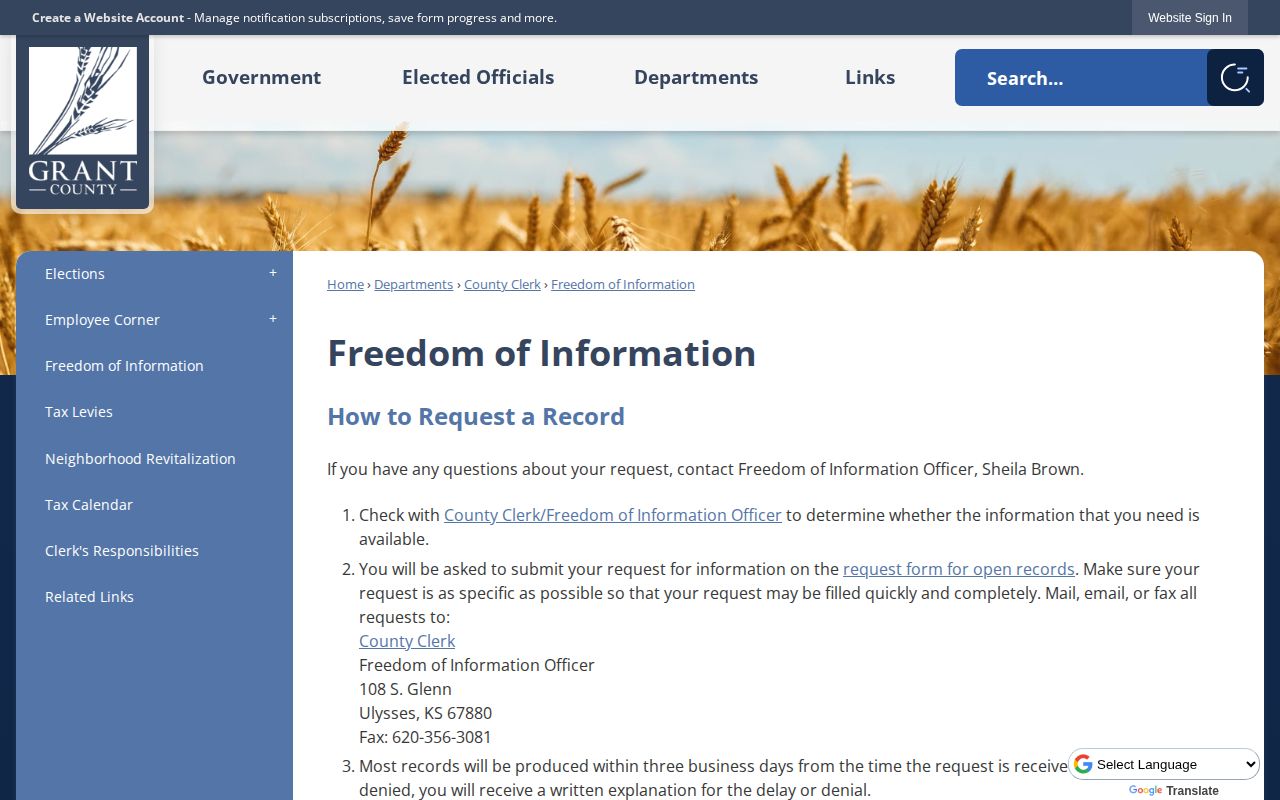
The county page directs unresolved requests to the official FOI process, which is the right fallback when a phone inquiry cannot yield the maintained release entry.
Note: Use the FOI office title because Grant County pages conflict on the individual officeholder’s name.
Grant County Release Record Law
The Kansas Open Records Act, K.S.A. 45-215 through 45-223, sets a policy of public access subject to statutory exceptions. K.S.A. 45-220 permits written procedures but prevents rejection of a discernible request merely for a technical defect. K.S.A. 45-221 lists records that may be closed, including qualifying criminal investigation material.
Open and closed parts can coexist. Kansas Attorney General guidance says jail rosters and jail books are open, while a mugshot or standard arrest report may be closed in the custodian’s discretion. Juvenile, sealed, expunged, victim-identifying, medical, privileged, and security information can also face limits.
No Grant County online release archive or retention window was found. Ask GCSO which retention schedule applies when record age matters. Court dockets and KASPER often persist longer, but each documents a different stage and cannot replace the jail’s physical processing entry.
Correct Grant County Release Entries
GCSO Records is the local route for obtaining or questioning a Grant County jail release entry. No official correction workflow or property-return process was published. Call first, identify the exact disputed field, and follow with a precise written request instead of assuming a fixed procedure.
The record custodian matters. A wrong county release time belongs with GCSO. A disputed court order belongs with the Grant County District Court clerk. KASPER public-data corrections use the separate KDOC address, kdoc_pub@ks.gov, while sentence computation questions go to the KDOC Sentence Computation Unit at 785-296-3317.
Property questions should also go directly to GCSO. No release gate, pickup schedule, waiting location, transport program, or property fee was verified. Avoid relying on visitation rules because digital visitation procedures say nothing about the release counter.
Find Grant County Released Inmates
Begin by naming the last custody system. For an adult booked at Grant County Jail, search Kansas VINE for the specific person and call GCSO. Ask whether the person remains in county custody. If not, ask for the release timestamp, manner, and destination. A missing online roster result cannot do this because Grant County publishes no current roster or recent-release feed.
- Check VINE for a Grant County Jail custody event and verify the reporting agency.
- Obtain the GCSO release entry or direct confirmation for the physical exit.
- Read the matching Grant County court case for bond, dismissal, sentence, revocation, or commitment authority.
- Search KASPER when a felony sentence, KDOC transfer, parole, postrelease, or discharge may apply.
- Use BOP or ICE only for the matching federal custody type, then reconcile that result with the local destination entry.
The Released Last 24 Hours page explains the same-day fallback when the expected county feed is absent. For any named-person search, use two sources when possible. An event source shows that custody changed. A durable source explains where the person went or which legal act authorized the change.
Grant County Court Release Clues
Grant County criminal cases are in Kansas’s 26th Judicial District. The clerk’s office is at 108 S. Glenn, second level, Ulysses, KS 67880, with phone 620-356-1526. Search the statewide portal by exact party name, then narrow to Grant County and the criminal case type. Match the case number and event dates before attributing a docket.
Read filed entries instead of relying on “closed.” Bond, dismissal, plea, sentence, jail credit, probation, commitment, revocation, and discharge can all explain a custody transition. A bond order gives legal authority but may precede payment, resolution of holds, or jail processing. A commitment entry can show that departure from the local jail was a state transfer.
The successful Grant County District Court source capture identifies the local courthouse channel.
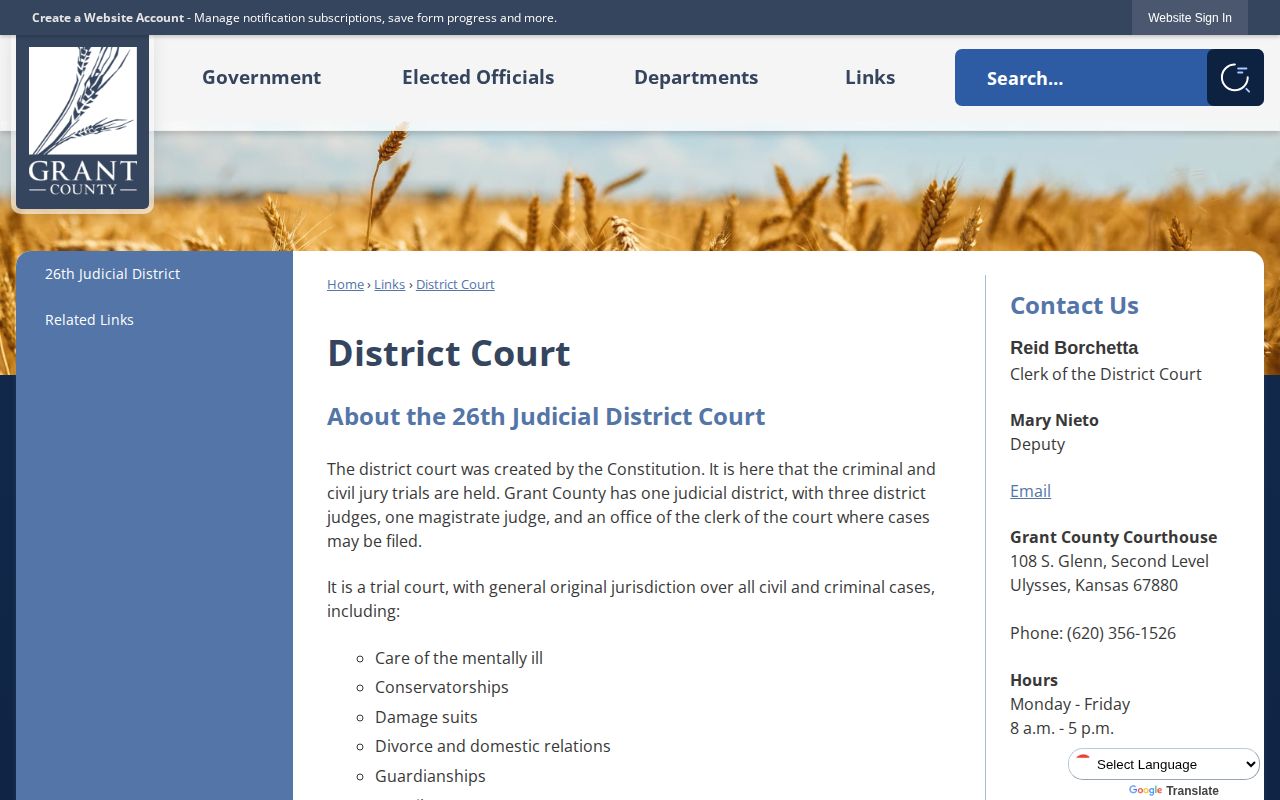
The court source supplies legal cause, while GCSO supplies the completed physical release time. Together they provide a stronger finding than either record alone.
Note: Sealed, expunged, juvenile, and other restricted cases may not appear in the public court portal.
Grant County KASPER Release Search
KASPER is the Kansas Adult Supervised Population Electronic Repository. It covers people sentenced to the Secretary of Corrections since 1980 who meet KDOC’s stated scope, including current prisoners, people on specified post-incarceration supervision, and people discharged from sentence. It is not a Grant County booking search or a full criminal history.
Basic search fields include last, first, and middle name, alias choice, KDOC number, photo-only choice, and thumbnail choice. Advanced options include State ID or KBI number, race, gender, date of birth or age range, and conviction county. Selecting Grant as conviction county can narrow identity, but does not establish present residence.
Open the full record. Review current and movement locations, movement dates, custody or supervision level, supervising parole office, conviction case, and discharge information. “Anticipated Release Date” is an estimate. Passing it does not prove that release occurred. A current institutional location still means custody, while a supervision location can support prison release into parole or postrelease.
The KASPER search and disclaimer capture shows the official state search entry.
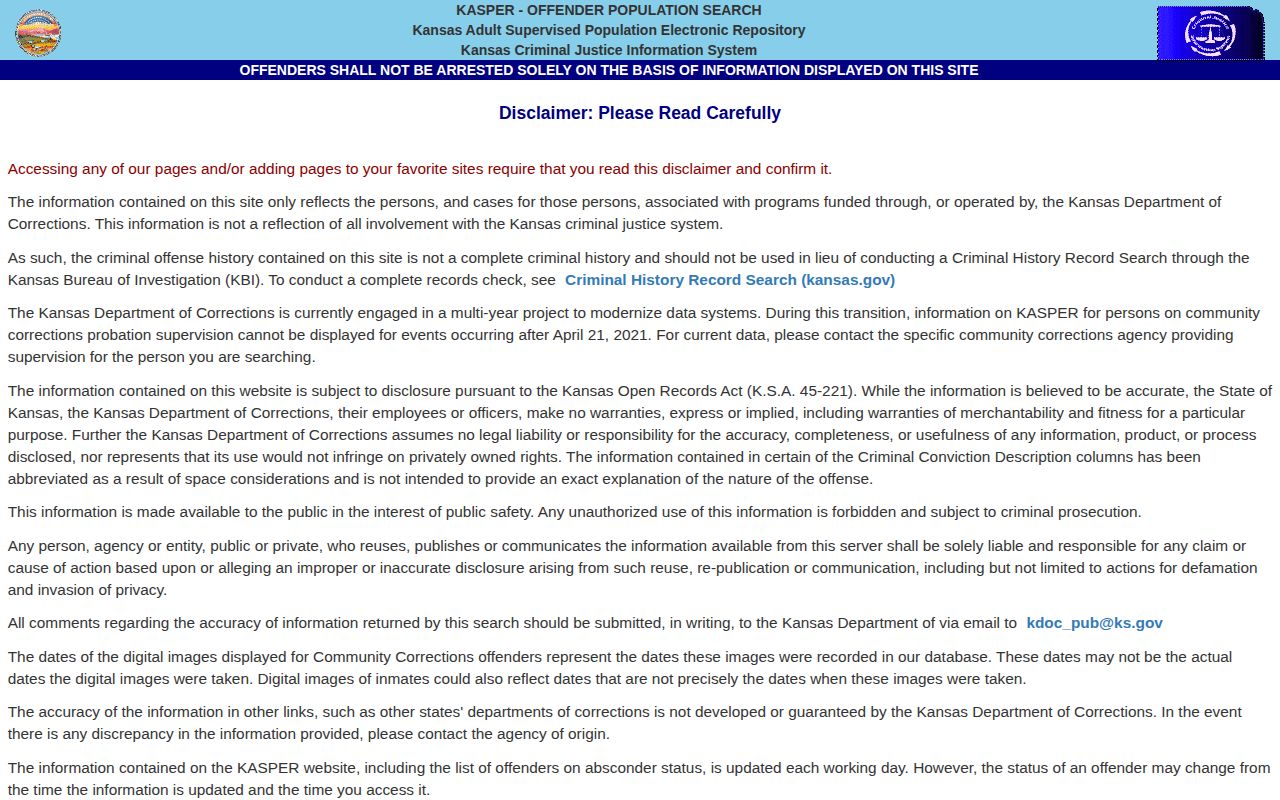
KDOC says KASPER updates on working days. A recent transfer or release can lag, and community-corrections probation events after April 21, 2021 have a stated display gap. Contact the relevant supervision agency when that gap applies.
Grant County Release Alerts
Kansas Victim Information and Notification Everyday covers adult offenders housed in Kansas county jails. Search VINELink by name or available identifier, compare the reporting agency, and open the matching record. A released result records a custody change from the reporting jail, not the person’s final destination.
While the person is in custody, notification can be registered through phone, text, email, app, or available TTY channels. Kansas guidance uses a four-digit PIN for phone calls. Alerts can say release, transfer, or escape, and those events must not be merged. VINE excludes KDOC state prisons, so KASPER is the state-prison channel.
The KBI Registered Offender Search applies only to people with a statutory registration duty. It can show post-custody information for that limited population, but absence from the registry says nothing about most released people.
Grant County Federal Release Checks
The BOP Inmate Locator covers federal inmates from 1982 forward. Results can show name, register number, release date, and location or status. A past date with “Released” or “Not in BOP Custody” supports departure from BOP, but does not rule out supervision, state custody, local custody, or immigration detention.
ICE’s Online Detainee Locator uses a nine-digit A-number plus country of birth or exact biographical details. ICE states that its attorney resource can include people released from ICE custody within the prior 60 days. An ICE release is only an ICE event. A GCSO entry stating release to ICE is the earlier handoff into that system.
No BOP prison or verified ICE contract facility was found in Grant County. A federal or immigration hold can still lead to transport. Request the destination and timestamp from GCSO, then use the correct federal locator. The U.S. Marshals Service does not maintain a comparable public nationwide historical release list.
Grant County Custody Status Comparison
Each system uses a different record vocabulary. The safest conclusion names the agency and event rather than making a broad claim about the person. This also prevents a projected date or court order from being mistaken for a completed exit.
| Source | Still held clue | Release clue |
|---|---|---|
| Grant County Jail | GCSO confirms local custody | Release entry gives time and manner |
| Kansas VINE | Current county-jail status | Release alert, subject to confirmation |
| KASPER | Institutional location and custody status | Supervision movement or discharge status |
| District Court | Remand, hold, or commitment order | Bond, dismissal, or discharge authority |
| BOP | Federal institution location | Past release date and no BOP custody |
| ICE | Current locator result | Recent ICE release result within stated scope |
Does a bond order prove release? No. It may authorize release, but another hold, unmet term, or jail processing can delay departure. Obtain the jail timestamp.
Grant County Jail Release Context
The sheriff’s staff page describes a jail built in the 1970s with space for up to 40 prisoners and four full-time jail deputies working two 12-hour shifts. Capacity does not equal average population and cannot support an estimate of yearly releases. No official annual release count or average stay was found.
In 2023, Grant County voters rejected both a proposed jail revenue bond, 329 to 570, and a related one-percent sales tax, 323 to 581. Those certified results support a narrow point: the proposal did not pass. They do not prove that no later work occurred, and the facility should not be described as a completed new justice center.
Staffing and building age also do not establish release speed. No fixed release hour, weekend rule, property-return schedule, gate payment, or transport program was published. Ask about the specific booking rather than deriving operations from capacity or election history.
Grant County Juvenile Release Records
A KBI release documents at least one Grant County youth transported to Southwest Kansas Regional Juvenile Detention Center. That event shows why absence from the adult jail can mean a transfer. It does not prove a current universal placement rule for Grant County youth.
Juvenile detention is not an adult released-inmate channel. Confidentiality rules and the juvenile court control access. Authorized family or counsel should contact the court or operating agency instead of placing a child into the public adult search workflow.
Grant County Release Facilities
The facility map includes the local jail and the separate systems that may receive or later release someone connected to Grant County. It does not claim that each system has a physical institution inside the county.
- Grant County Jail: GCSO records local adult jail exits, including community release and transfers.
- Southwest Kansas Regional Juvenile Detention Center: juvenile access follows confidential court and agency channels.
- Kansas Department of Corrections: KASPER records the state prison, supervision, and discharge phases.
- Federal Bureau of Prisons: the BOP locator covers federal imprisonment and release from BOP custody.
- ICE Detention: the federal locator handles current and limited recent ICE custody information.
Start with the custodian of the event being verified. Then use the destination record to trace any continued custody. This sequence keeps county release, state discharge, federal release, and immigration custody from being treated as the same event.